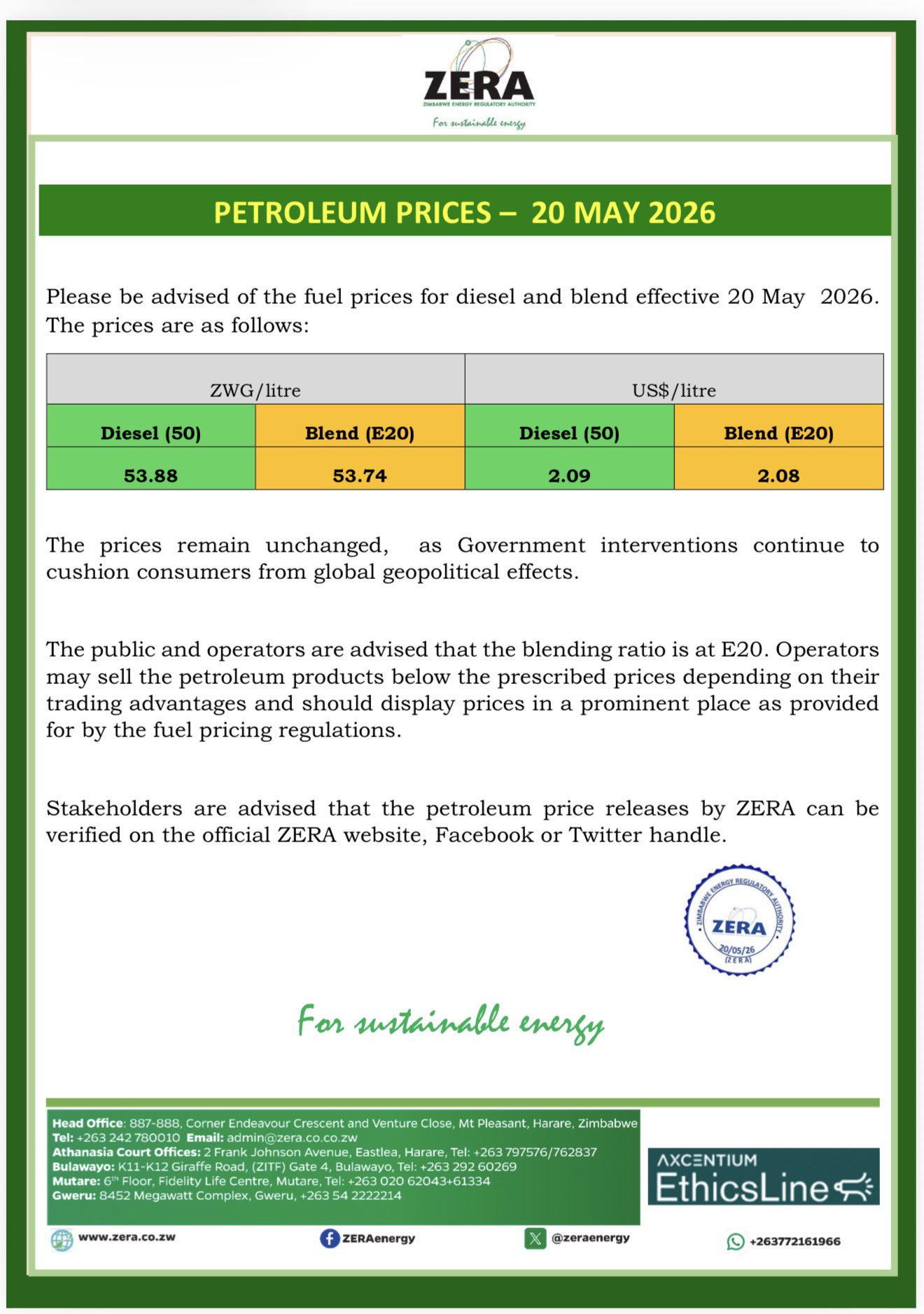
The Zimbabwe Energy Regulatory Authority (Zera) has once again held fuel prices steady, maintaining diesel at US$2.09 per litre and blended petrol (E20) at US$2.08 per litre in its latest review.
In a statement issued Wednesday, ZERA said the prices remain unchanged as “government interventions continue to cushion consumers from global geopolitical effects,” signaling continued efforts to shield the economy from international oil market turbulence.
The latest review marks another pause in fuel price increases after a period of sharp upward adjustments earlier this year.
In April, petrol rose to US$2.23 per litre from US$2.17 in March, while diesel increased to US$2.11 from US$2.05, as authorities responded to surging global procurement costs linked to instability in the Middle East.
At the time, Zera warned that international pressures were intensifying, noting that diesel free-on-board (FOB) prices had jumped by 33.16 percent, while petrol costs climbed by 5.96 percent. The regulator argued that regular fortnightly reviews were necessary to prevent supply distortions, shortages, and arbitrage.
Despite those pressures, the government moved decisively to contain domestic price shocks by suspending several diesel-related taxes and levies from April 3.
The relief measures included the removal of excise duty, the Zimbabwe National Roads Authority road levy, carbon tax, and the strategic reserve levy, a package estimated to reduce diesel costs by about US$0.54 per litre.
Finance Minister Mthuli Ncube described the intervention as an extraordinary but necessary response to protect productive sectors from imported inflation.
“This bold and unprecedented measure reflects the government’s commitment to protecting both consumers and productive sectors from external shocks,” he said at the time.
The tax relief has been particularly significant for transport operators, miners, farmers, and manufacturers, all heavily reliant on diesel for daily operations.
Zera has also sought to reassure the market over fuel availability, saying Zimbabwe has more than three months’ supply cover through stocks held in Beira and inland storage facilities. Authorities are also diversifying supply routes, including allowing diesel imports by road alongside pipeline and rail transport.